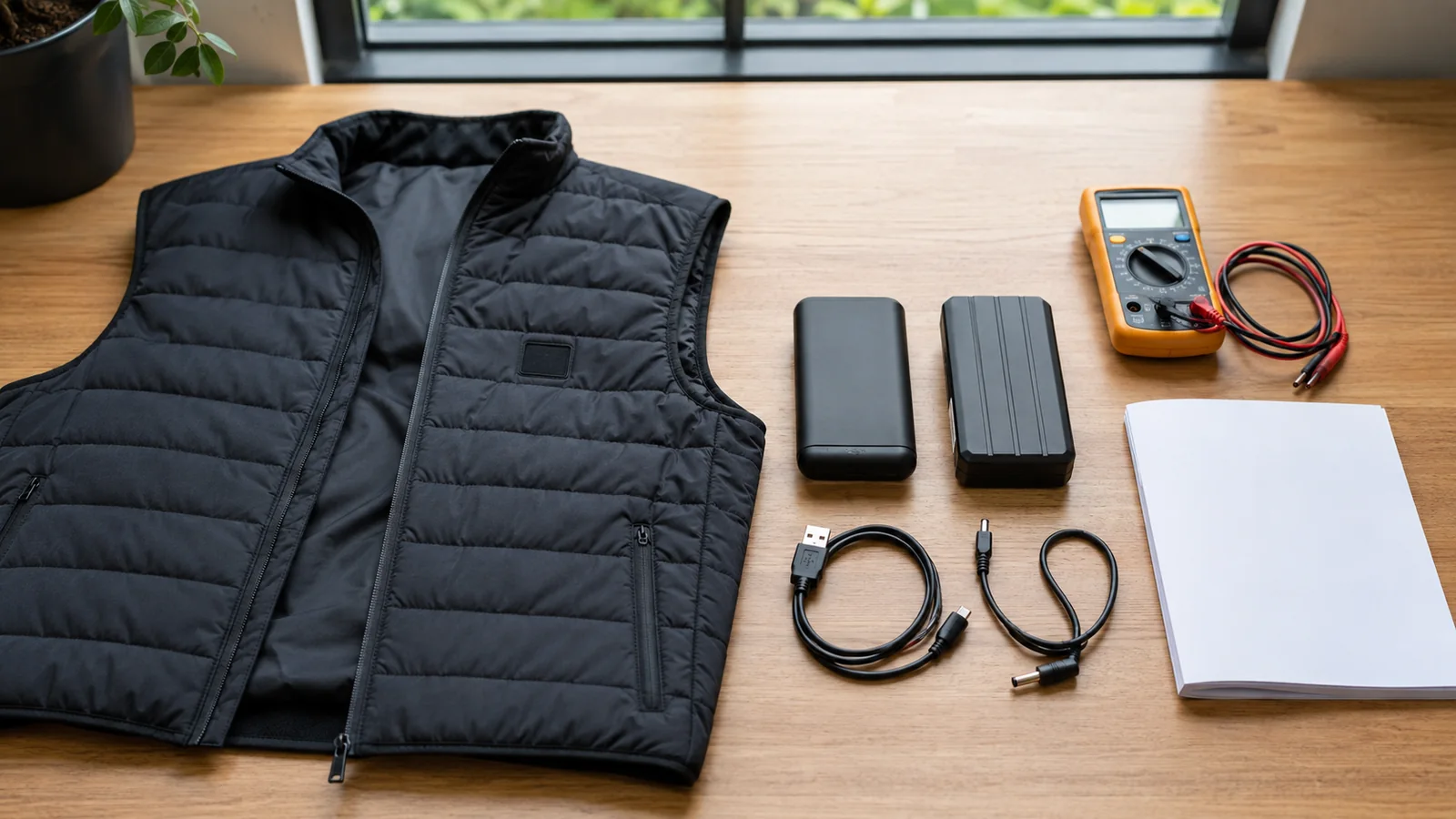
Heated Vest Replacement Batteries: Compatibility and Safety Guide
Disclosure: My Pick Review may earn a commission when you buy through links on this page. This does not affect our editorial conclusions.
A heated-vest battery is not automatically interchangeable with another pack simply because the connector fits. Voltage, connector dimensions, polarity, output current, controller requirements, and charger compatibility must all match.
This guide explains how to identify the correct replacement without guessing. It does not recommend a universal battery, and it does not replace the vest manufacturer’s instructions.
Quick answer
The safest choice is the exact replacement battery listed by the vest manufacturer for your model. If that is unavailable, do not buy a substitute until you have verified the required output voltage, connector type and polarity, sufficient current output, and charging method. Matching capacity alone is not enough.
Why heated-vest batteries are not universal
Heated vests use resistive heating elements controlled by electronics inside the garment. The battery must supply power within the range expected by that system. Two packs may look similar while producing different voltage or using opposite connector polarity.
An incorrect battery can prevent the vest from working, trigger protection circuitry, damage the controller, overheat a cable, or create a battery-safety risk. Never force a connector or improvise an adapter without explicit manufacturer support.
The six-point compatibility checklist
1. Required output voltage
Look for the output voltage on the original battery label, vest label, manual, or manufacturer support page. Common-looking USB and barrel-connector systems can use different voltages. The replacement’s output must match the garment’s requirement—not merely fall somewhere close.
2. Connector type and dimensions
Identify whether the garment uses USB-A, USB-C, a round barrel connector, or a proprietary plug. For barrel connectors, both outside and inside dimensions matter. A plug that enters the socket can still be the wrong size.
3. Connector polarity
Barrel connectors may be center-positive or center-negative. Look for the polarity symbol on the original pack or manual. Reversed polarity can damage electronics even when voltage and plug size match.
4. Output current and power
The replacement must safely provide at least the current the vest requires at the correct voltage. A pack with inadequate output may shut down, cycle unexpectedly, or run hot. Higher advertised capacity does not compensate for an incompatible output specification.
5. Controller or communication requirements
Some garments use a proprietary battery, cable, or electronic handshake. A generic power bank may not activate the controller even when its connector and headline voltage appear suitable.
6. Charger compatibility
Use the charging method approved for the replacement pack. A charger’s output specifications are separate from the battery output used by the vest. Do not assume the original charger is safe for a different battery.
USB-powered versus barrel-connector vests
A vest with a conventional USB input may appear easier to match, but you still need to verify the required power mode. Some USB-C devices negotiate voltage electronically, while others expect a fixed USB output. For example, the current Solana Gear Heated Vest documentation specifies a minimum 5V/2A power source. Check the manual rather than assuming every USB-C power bank will work.
Barrel-connector systems require particular care because visually similar plugs can differ in dimensions and polarity. Use exact manufacturer specifications.
Capacity and runtime: why mAh can mislead
Battery capacity is often expressed in milliamp-hours, but comparing mAh across different voltages can be misleading. Watt-hours provide a more useful energy comparison:
Watt-hours = nominal voltage × amp-hours
For example, a capacity figure measured at the battery cells’ internal voltage should not be compared directly with another pack advertised at its output voltage. Conversion losses, temperature, heat setting, battery age, and garment fit also affect runtime.
Treat maximum runtime as a conditional manufacturer claim. Higher heat settings normally consume energy faster than lower settings.
Where to find the original requirements
- The label on the original battery
- The label inside the battery pocket
- The garment care or specification label
- The printed manual
- The manufacturer’s support page
- Written confirmation from manufacturer support
Photograph the original labels before they wear or fade. Record the vest’s exact model number, not only the brand.
Warning signs: stop using the battery
- Swelling, cracking, puncture, or leakage
- Unusual heat while idle, charging, or operating
- Burning or chemical odor
- Corroded, bent, loose, or discolored connectors
- Intermittent power when the cable moves
- A battery that has been submerged or severely impacted
Disconnect a suspect battery when it is safe to do so. Follow local guidance for lithium-battery disposal; do not place a damaged lithium battery in ordinary household trash.
Should you buy a larger-capacity replacement?
Only if the manufacturer confirms compatibility. A higher-capacity pack may be physically larger or heavier, may not fit securely in the pocket, and may use different electronics. Battery-pocket comfort is part of compatibility because a loose or overloaded pocket can strain the cable.
Model-by-model research rule
My Pick Review will add a compatibility table only after the original voltage, connector, polarity, and output requirements are documented for each vest. We will not infer compatibility from product photos or recommend a “universal” battery because its plug appears to fit.
Frequently asked questions
Can I use a normal phone power bank?
Only if the vest manufacturer says the required output and protocol are compatible. USB connector shape alone does not prove compatibility.
Can I use an adapter?
Do not use an adapter unless it is explicitly supported for the exact vest and battery combination. An adapter does not correct incompatible voltage, polarity, or power negotiation.
Why does my vest switch off on high?
Possible causes include low charge, battery protection, inadequate output, a loose connection, cold battery conditions, or a garment fault. Stop using it if the pack or cable becomes unusually hot and consult the manufacturer.
For runtime estimates, use our heated-clothing battery runtime calculator. If you are comparing complete vests rather than replacement packs, start with our heated-vest comparison.
Bottom line
Start with the vest model and original electrical requirements, then match every relevant specification. When information is incomplete, buying the manufacturer’s documented replacement—or asking support—is safer than experimenting.
Learn more in our guide to how heated vests work and our heated-vest sizing and layering guide.
As an Amazon Associate I earn from qualifying purchases.